
Grading Deep Tendon Reflexes Explained
Reflexes are involuntary contractions of muscles in response to a stimulus and are classified as deep tendon, superficial, or pathologic. The most common reflexes tested are the deep tendon reflexes which include the biceps, triceps, brachioradialis, quadriceps (patellar), and Achilles (ankle).
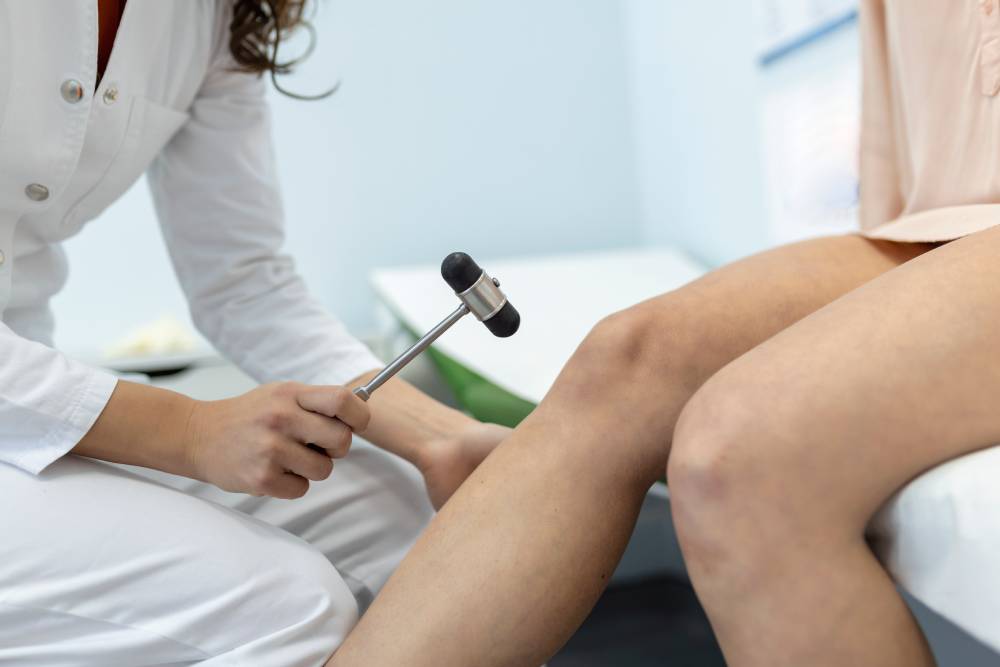
When testing deep tendon reflexes, it is important to ensure your patient is completely relaxed, as these reflexes can be challenging to elicit when the muscles are tense.
Strike the tendons in the following areas:
- Biceps reflex – just anterior to the elbow
- Triceps reflex – just posterior to the elbow
- Brachioradialis reflex – about 2 to 4 inches above the wrist on the radial aspect of the forearm
- Quadriceps (patellar) reflex – just below the patella
- Achilles (ankle) reflex – just behind the ankle
Scale for Grading Deep Tendon Reflexes
Note the reflex response's speed, force, and amplitude and grade the response using the following 0 to 4 scale. Always compare the response of one side with the other.
Grade: | Description: |
0 1 2 3 4 | No reflex response Diminished reflex response Normal reflex response Increased reflex response Very brisk reflex response |
Reinforcement
If a reflex is reduced or absent, try using reinforcement to increase reflex activity. Reinforcement involves isometric contraction of other muscles for up to 10 seconds, which can increase reflex activity.
For example, ask the patient to clench the teeth or squeeze both knees together to reinforce the arm reflexes. If the leg reflexes are decreased or absent, have the patient lock their fingers together and pull one hand against the other. Ask the patient to pull just before you strike the patella or Achilles tendon.
Interpreting Deep Tendon Reflexes
As you perform your assessment, test the reflexes on one side immediately after testing the corresponding reflex on the other instead of testing all reflexes in one limb and then testing the other.
If reflexes are brisk, it may be challenging to detect asymmetry. Try to lighten the stimulus until it just barely elicits a response. Check for and document the following:
- Is the threshold stimulus the same on each side, or do you need to hit harder on one side than the other?
- If the threshold stimulus is the same on each side, does it elicit the same level of response on each side?
Key points to remember:
- Ensure the joint is fully relaxed at a 90-degree bend.
- Strike the joint only with enough force to elicit a response.
- If a reflex is reduced or absent, try using reinforcement to increase reflex activity.
- Check for asymmetry in reflex responses between the right and left sides of the body.
Practitioner Development UK (PDUK) is a leading provider of continuing professional development (CPD) courses for healthcare professionals. We offer a wide range of courses, delivered both virtually and in-house.
We highly recommend the following course related to comprehensive patient assessments in primary care settings:
A03 Five-day patient assessment skills workshop: Face to Face
This five-day programme provides practitioners with the skills and knowledge they need to perform a complete physical examination. The course covers the principles of taking a safe, structured patient history and the physical examination techniques used to assess each of the major body systems.
Participants will have the opportunity to practice their skills on standardized patients and receive feedback from experienced clinicians.
Article information
Written by: Practitioner Development UK
Reviewed by: Dr Debra Sharu, Practitioner Development UK
Last reviewed and updated: 14 May 2026
Medical disclaimer: This article is for general educational information only and is not a substitute for professional medical advice, diagnosis or treatment. Assessment of deep tendon reflexes should be carried out by an appropriately qualified healthcare professional as part of a wider clinical examination. Any new, unexplained or concerning neurological symptoms, such as weakness, numbness, loss of coordination, severe headache, altered consciousness, or sudden changes in reflexes, should be assessed urgently.
Images supplied by: Designed by Magnific